
From Volume to Value: What the Latest ELT Data Could Mean for London Schools

UK ELT in 2025: What the Latest Global Data Means for London Schools
The UK remains the leading English language destination by student numbers among the major ELT destinations analysed, despite another challenging year for the global English language teaching sector.
The newly published The global position of the UK ELT sector in 2025, prepared by BONARD on behalf of English UK, places the performance of the UK within the wider international ELT market, comparing it with Australia, Canada, Ireland, Malta, New Zealand, South Africa and the USA.
The findings show a market that is becoming smaller, more competitive and increasingly shaped by shorter stays and junior mobility. At the same time, the UK continues to hold a comparatively strong international position.
For English language schools in London, the message is therefore not simply one of declining demand. Instead, the data points towards a changing market in which student mix, programme duration, source-market diversification and value per student are becoming increasingly important.
A second year of decline for global ELT
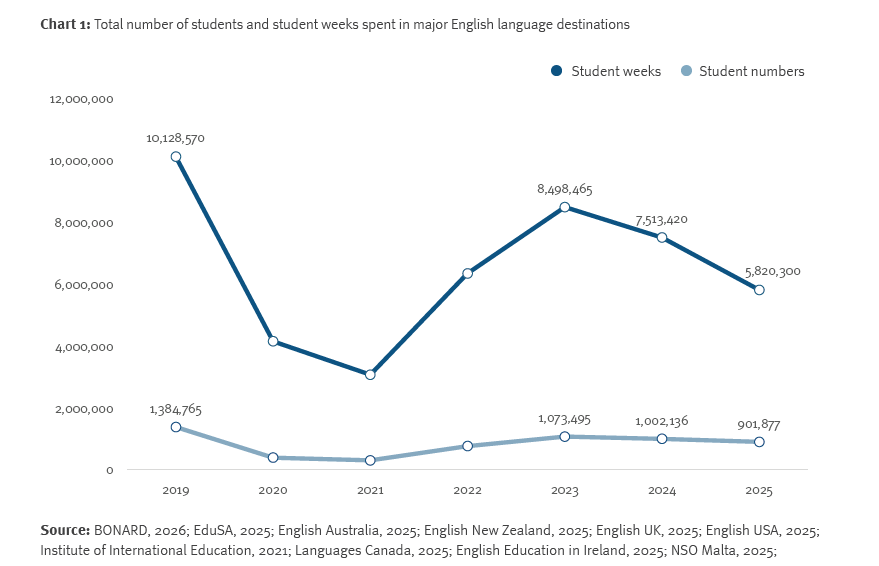
Across the eight major ELT destinations analysed, 901,877 students studied English in 2025, generating approximately 5.82 million student weeks.
Compared with 2024, international student numbers fell by 10%, while student weeks declined significantly more sharply, by 23%. This followed declines of 7% in student numbers and 12% in student weeks during 2024.
The difference between the decline in student numbers and the much larger fall in student weeks is particularly significant.
It suggests that the sector is not only receiving fewer students: study patterns are also changing, with longer-duration adult programmes facing greater pressure while shorter programmes and junior students become relatively more important.
The report identifies government policy and affordability as two of the main factors behind this change. Visa and immigration measures have affected access to longer-term study in some destinations, while rising costs are leading some students to choose shorter programmes, alternative destinations or online provision.
The UK remains the leading destination by student numbers
Against this difficult global backdrop, the UK continues to hold a strong competitive position.
In 2025, 39% of all students studying across the eight major ELT destinations analysed chose the UK.
The UK therefore remained the largest destination in the group by student numbers.
However, its share of global student weeks was considerably lower, at 21%.
This difference provides one of the most important messages from the report.
Student numbers alone no longer tell the whole story.
As shorter programmes become more prominent, destinations and individual schools may maintain relatively strong student headcounts while experiencing greater pressure on total student weeks.
For providers, measures such as average length of stay, programme value, capacity and profitability are therefore becoming increasingly important alongside headline enrolment figures.
Junior students are reshaping the UK market
One of the clearest changes identified by the report is the growing importance of junior students.
Juniors accounted for 62% of UK ELT students in 2025 — the highest proportion among the six destinations for which comparable adult and junior data was available.
This compares with 54% in 2022.
The increase in the junior share reflects both the relative resilience of junior demand and a decline in adult mobility.
This creates both opportunities and challenges.
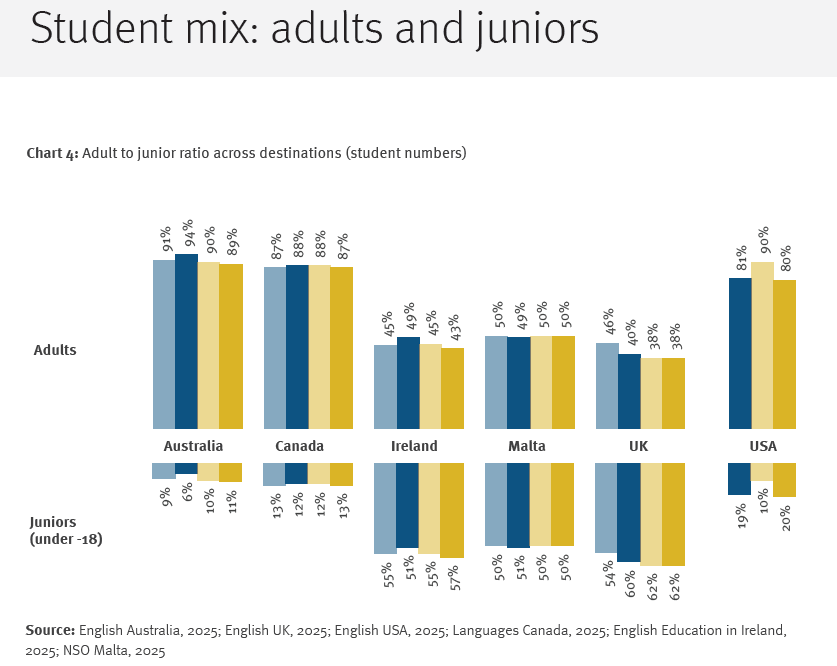
Junior programmes are typically shorter than adult courses, meaning that high student numbers do not necessarily generate the same volume of student weeks. At the same time, junior programmes are often delivered as packages incorporating accommodation, activities, excursions and additional services, creating opportunities to generate greater value per student per week.
Adult students nevertheless remain extremely important to the sector.
Although juniors represented 62% of UK students, English UK member data shows that adults generated 67% of student weeks in 2025.
For providers, maintaining adult demand while continuing to develop successful junior programmes is therefore likely to remain an important balance.
Source markets are changing
The decline in global ELT demand was widespread rather than being driven by one particular country.
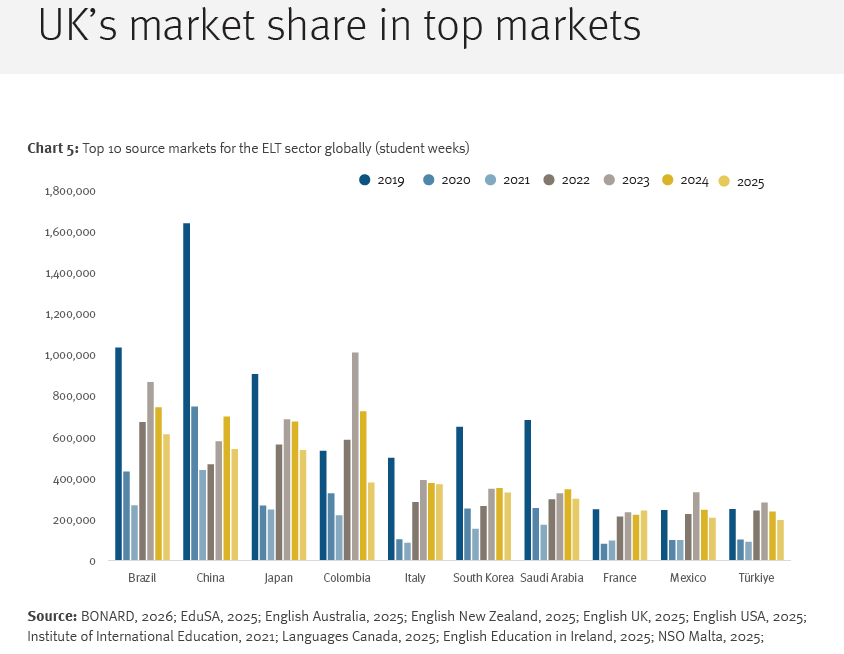
Nine of the ten largest source markets by student weeks declined during 2025.
Colombia recorded the largest fall, with student weeks declining by 48%. China declined by 22%, Japan by 20%, Brazil by 18%, Türkiye by 17%, Mexico by 16% and Saudi Arabia by 14%.
Brazil nevertheless became the largest ELT source market globally, generating 614,982 student weeks.
France was the major exception to the wider trend, growing by 10% to 243,889 student weeks, while Italy proved comparatively resilient with a decline of only 2%.
These figures are important because a decline in UK volumes from an individual country does not automatically mean that the UK is becoming less competitive.
If the overall international market from that country is contracting, the UK can potentially receive fewer students while still increasing its share of the available demand.
Where is the UK gaining market share?
There are several encouraging signs within the source-market analysis.
Latin America stands out particularly strongly.
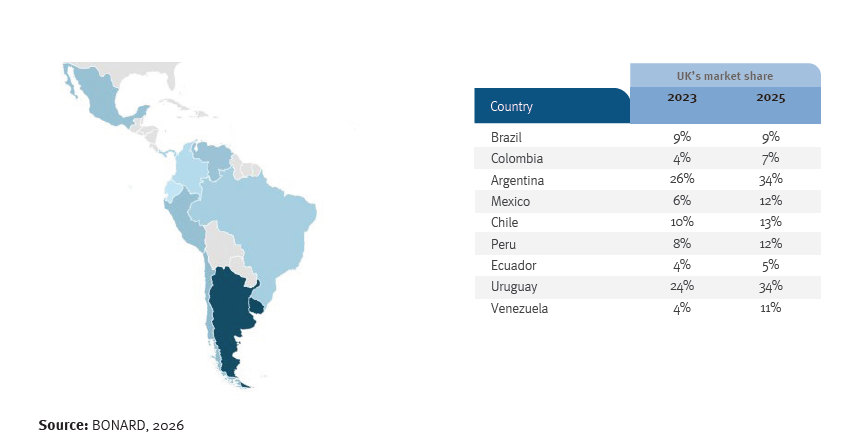
Between 2023 and 2025, the UK’s share increased from 4% to 7% in Colombia, from 26% to 34% in Argentina, from 6% to 12% in Mexico, from 10% to 13% in Chile, from 8% to 12% in Peru, from 24% to 34% in Uruguay and from 4% to 11% in Venezuela. Brazil remained stable at 9%.
The picture in Western Europe is more mixed.
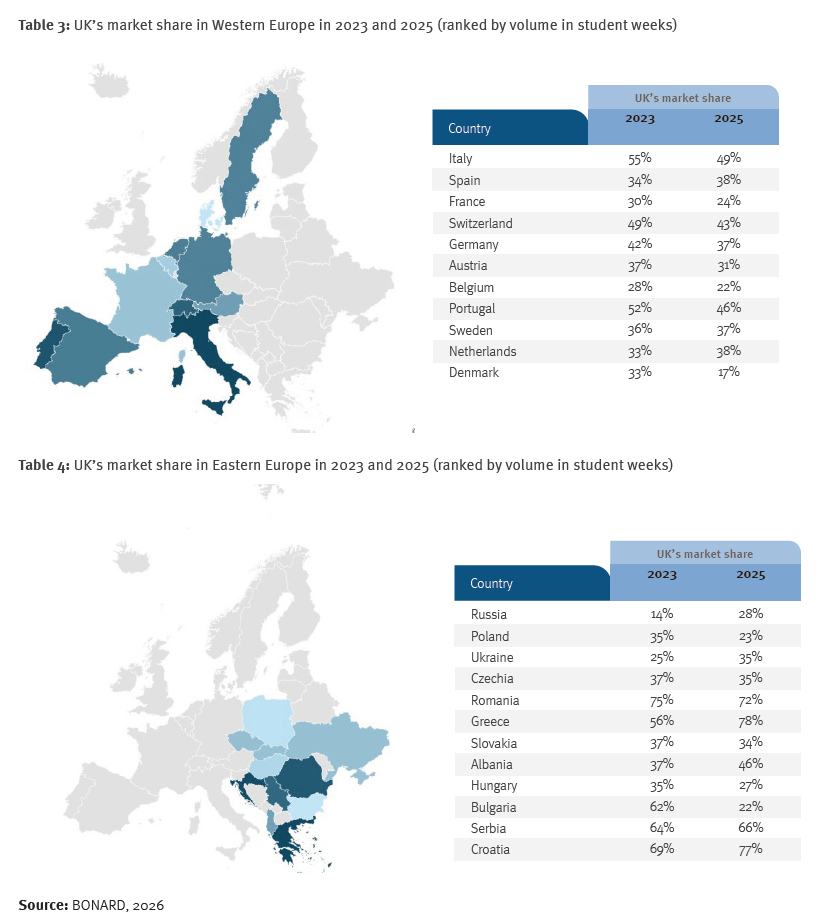
The UK increased its share in Spain from 34% to 38%, Sweden from 36% to 37% and the Netherlands from 33% to 38%.
However, its share declined in several important markets, including Italy, from 55% to 49%; France, from 30% to 24%; Germany, from 42% to 37%; and Portugal, from 52% to 46%.
There are also significant movements elsewhere.
In the Middle East, the UK’s share increased substantially in Türkiye, from 25% to 56%, Kuwait from 50% to 73% and Iraq from 18% to 63%.
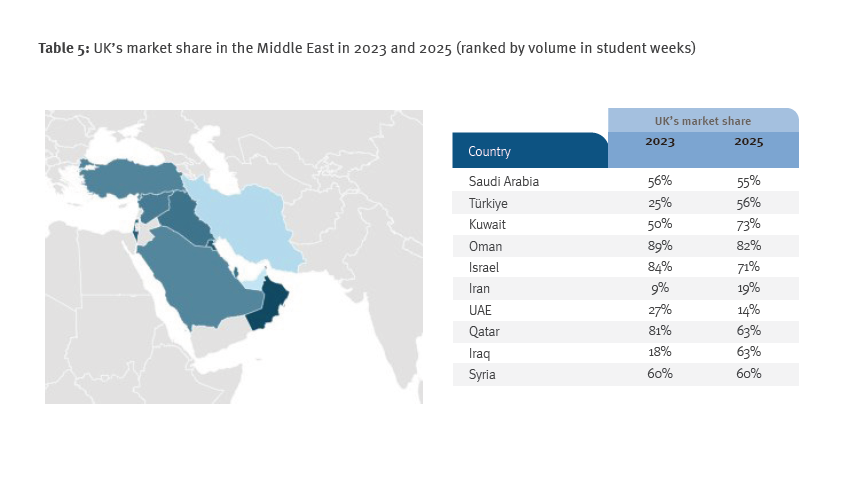
At the same time, its share declined in markets including Israel, from 84% to 71%; the UAE, from 27% to 14%; and Qatar, from 81% to 63%.
The overall picture supports one of the report’s central conclusions: the UK has increased its share in several international markets, particularly across Latin America and parts of the Middle East and Eastern Europe, but these gains should be viewed in the context of an overall market that has become smaller.
What does this mean for London’s English language schools?
Although the report analyses the UK as a whole rather than London separately, several implications are particularly relevant for schools operating in the capital.
Firstly, the sector may need to move beyond measuring success primarily through student headcount.
The significant difference between the UK’s 39% share of students and its 21% share of student weeks demonstrates the importance of course duration.
For schools, measures such as student weeks, average length of stay, programme value and profitability are likely to become increasingly important alongside enrolment numbers.
Secondly, the continued resilience of junior demand creates an important opportunity.
London schools with strong junior, group and young learner provision may be well placed to respond to this shift. However, increased numbers of short-stay students can also create additional operational pressures around accommodation, staffing, capacity and programme delivery — areas specifically highlighted in the report.
Thirdly, adult recruitment should remain a priority.
The fact that adults continue to generate the majority of student weeks shows why maintaining longer-stay adult business remains commercially important, even as juniors represent a larger proportion of overall student numbers.
Finally, source-market diversification is likely to become increasingly important.
The changes across Latin America, Europe, the Middle East and Asia show that international demand is not moving uniformly. Some countries are becoming more favourable to the UK, while others are becoming more competitive or contracting more rapidly.
For London schools, closely monitoring these shifts and maintaining strong international recruitment networks will therefore remain important.
What does the report predict for 2026?
The report is cautious about the immediate outlook.
The UK enters 2026 in what BONARD describes as a relatively strong global position. Although the sector declined in 2025, the UK performed better than several other major ELT destinations and retained its position as the largest market by student numbers among the destinations analysed.
However, a strong competitive position does not necessarily mean a return to volume growth.
The report states that 2026 is likely to remain challenging.
Affordability pressures continue as the cost of travel, accommodation and studying abroad rises, while geopolitical instability — particularly in the Middle East — creates additional uncertainty around an important source region for UK ELT.
Early 2026 data from English UK’s quarterly intelligence scheme, QUIC, also indicates that UK ELT volumes remain under pressure.
Students also have an increasing number of alternatives, including lower-cost regional destinations and English language provision closer to home.
As a result, competition may increasingly be about protecting and increasing the UK’s share of existing demand rather than relying on the overall international ELT market to expand.
Looking ahead: value, adaptability and sustainability
Perhaps the most important conclusion for the sector is that the definition of growth may be changing.
The report suggests that maintaining the UK’s position will increasingly depend on protecting and growing market share, retaining adult demand where possible and adapting to a market characterised by shorter stays and greater junior mobility.

For London’s English language schools, this could mean putting greater emphasis on the overall value of each student journey rather than simply increasing student numbers.
Developing attractive short programmes, strengthening junior provision, maintaining compelling adult products and responding strategically to changing source markets may all become increasingly important.
The report ultimately points towards a shift away from pursuing volume alone and towards maximising the value of existing demand, with profitability and long-term sustainability becoming increasingly important measures of success.
The international ELT market is changing, and the immediate outlook remains challenging.
But the UK continues to occupy a strong position within the global market.
For London’s English language schools, the opportunity may therefore be less about waiting for international demand to return to previous levels, and more about adapting effectively to changing demand while protecting value, profitability and long-term sustainability.
Note: International comparison figures in the Global Context Report use estimates of the wider UK ELT sector and may differ from figures in English UK’s annual member-centre Student Statistics Report. The international comparisons are intended primarily to assess trends, relative performance and the UK’s position within the wider global ELT market.
